
Manual Ticket Count Updates Are Dead. The Intelligence Era Has Arrived.
There is a ritual in the booking agency world that has somehow survived decades of technological progress. Your agents and support staff are spending a staggering chunk of their week downloading TM1 reports, hunting through AXS exports, deciphering 30 different promoter formats, and chasing down updates.
"Hey, can you send updated counts for Nashville?"
"Let me pull those. Give me an hour."
Two days later, the counts arrive in a PDF that was clearly photographed from a screen.

Someone manually transcribes those numbers into a master spreadsheet that looks like it was designed in 1997, and sends it to the artist's management team as a "finished product." A static grid delivered late, with no way to see historical trends or know if the numbers are even current.
This isn't an exaggeration. This is Tuesday.
We built something to replace it. Not improve it. Replace it.
An Objectively Better Way
The fundamental problem isn't that booking agencies lack discipline, or that your staff isn't working hard enough. It's simply that the technology required to automate this workflow never existed. You couldn't build a better process because the infrastructure wasn't there.
But it is now. A faster, more accurate, and completely intelligent alternative actually exists.
Enter the Soundwave Intelligence Engine — purpose-built for exactly this workflow. What your agency actually needs isn't another third-party app — it's an automated pipeline that does the grunt work for you.
Any Ticket Count. Any Format. Any Time.
Every agency gets a dedicated ingestion email address. Promoters send their counts there — or your agents forward them. The system doesn't care about the format. Ticketmaster, AXS, Eventbrite, SeeTickets, DICE... it doesn't matter, you're good. csv, xlsx, pdf, doc, written in the subject line of the email? We got you.
Ticket count written in sidewalk chalk sent via a blurry photo taken on a 2004 Razr? No bullshit... it works reliably. We've built a crazy powerful optical recognition pipeline for exactly that.
The only thing that matters is that the data gets in. And from there, it becomes a living database — not a dead spreadsheet. Everything updates within ~60 seconds of receipt.
No one on your team touches a grid. No one copies and pastes. No one manually types "2,847" into a cell. The madness is over. The Intelligence era has begun.
The Agency Portal — Your Command Center
Your agency gets an entirely new view — purpose-built for the operational realities of managing a touring roster:

- Roster-Wide Pacing: See every artist, every tour, every show — color-coded by health status — in a single interactive map. The 3D geo-visualization shows you exactly where tickets are selling and where they aren't, across your entire portfolio.
- Promoter & Venue Intelligence: Track every promoter and venue your roster works with over time. Route smarter by booking into rooms that actually deliver.
- Responsible Agent Views: Each agent on your team gets a filtered view of only their assigned artists — with the same depth of analytics, pacing, and triage tools.
- Geographic Demand Indexing: Understand which markets are consistently strong for which genres, which DMAs are emerging, and where your roster has untapped opportunity.
The Client Experience — From Grid to Intelligence Portal
While your team is tracking the macro trends, your artists' management teams still get the "safety blanket" — the familiar ticket count grid, delivered on whatever interval you choose (daily, weekly, bi-weekly). Nothing changes about what they're used to receiving.

But now they also get a dedicated login to a portal that redefines what tour intelligence looks like:
- Advanced Data Visualizations: Interactive performance charts that show ticket sales velocity, momentum shifts, and day-over-day acceleration across every show on the tour — not just a static number in a cell.
- 4-Way Historical Baseline Averages: For every market, the system automatically surfaces how this artist (and comparable artists on your roster) have performed in previous plays at the same venue or in the same metro. Benchmarking isn't a research project anymore. It's a column in the dashboard.
- Clairvoyance — Predictive Forecasting: Using historical sales curves and real-time velocity data, the Intelligence Engine can forecast likely final ticket sales outcomes as early as one day after tickets go on sale. Instead of waiting until week 3 to know if a show is going to struggle, you know by day 2. That changes what levers you pull — and how early you pull them.
Automated Follow-Ups — The Triage System
For the promoters who are chronically late with their updates, the Intelligence Engine includes a Triage system. If a promoter hasn't checked in with an update, the system sends a polite follow-up from the agency's own domain — not from some third-party tool the promoter has never heard of. This maintains the relationship dynamic while completely eliminating the manual labor.
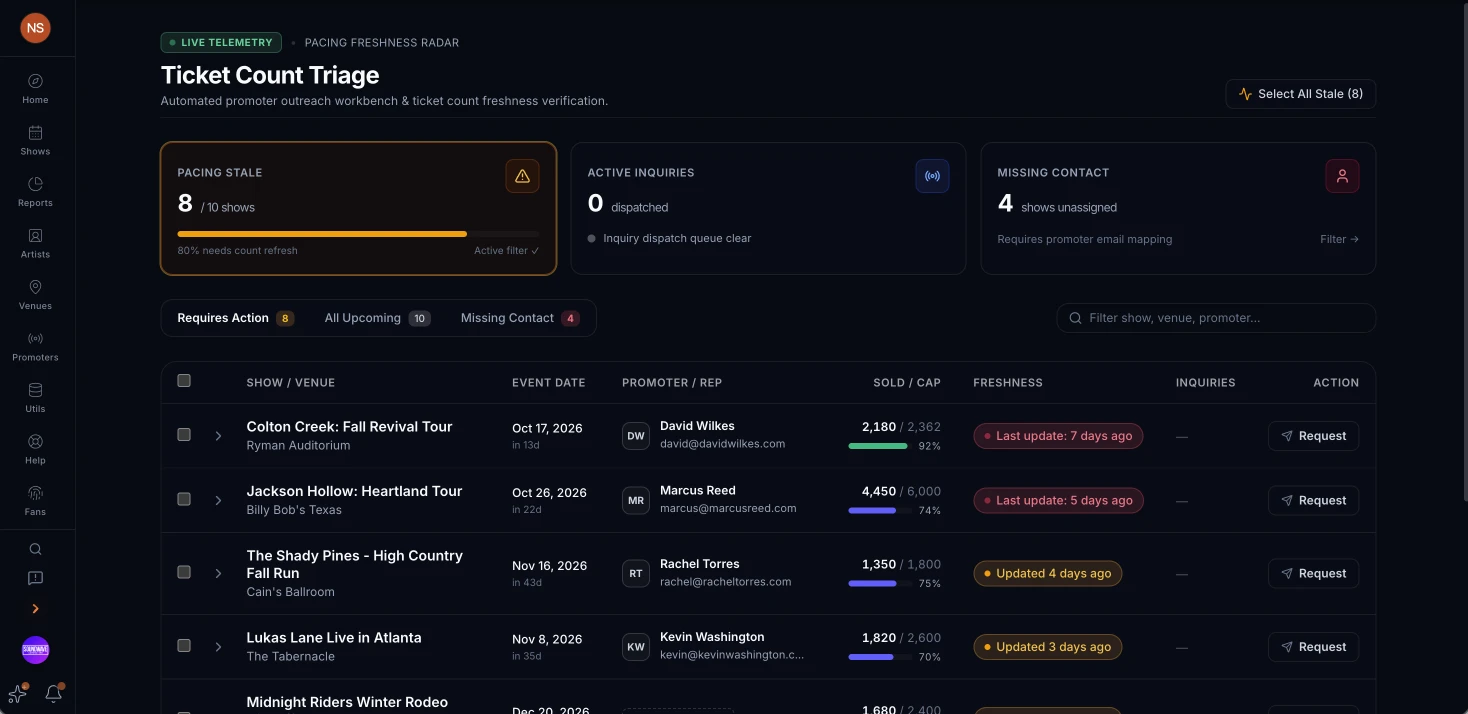
Each email includes a magic link — a pre-authenticated, mobile-optimized form that lets the promoter punch in their numbers from their phone in 30 seconds flat. No login required. No app to download. Tap the link, type the number, hit submit. Done.
The system tracks which promoters are consistently delinquent and surfaces that pattern to your team — so you can have the right conversation at the right time, armed with data rather than frustration.
The Math
Let's talk about what this actually costs your agency.
When you rely on manual ticket count collection, the financial drain goes far beyond the base salary of your assistants. The real cost is operational drag:
- The Time Drain: The average assistant spends 25% to 40% of their week (10–16 hours) acting as a human API — chasing promoters, parsing emails, and re-keying data into a master grid.
- The Burnout Tax: Talented young professionals don't join agencies to do monotonous data entry. This soul-crushing workflow drives a 12- to 18-month turnover cycle, costing you $4,000+ in lost productivity and training every time you have to replace someone.
- The Data Deficit: You are wasting expensive, finite labor bandwidth on a cumbersome, manual process just to get a static spreadsheet. You aren't even remotely close to tapping the actual potential of the data you're gathering.
Think about what the status quo actually represents: You are literally paying more money for a slower, less accurate, and fundamentally less valuable outcome.
The Intelligence Engine ends this. The data flows in automatically. The insights generate themselves.
Your team gets those 16 hours back to do what they are actually best at: booking shows, servicing clients, and helping your roster grow. The time for the old way to end is now.
The Shift
There's a deeper transformation happening here that goes beyond labor savings.
When your agency owns a living, growing database of every show your roster has ever played — every venue, every market, every promoter, every ticket sold, every sales curve — you stop operating on instinct and start operating on intelligence.
You stop asking promoters how a show is doing. You tell them.
You stop guessing which venue to book in a market. You know.
You stop hoping a tour is going to pace well. You forecast it on day one.
That's not an incremental improvement. That's a fundamentally different way of running an agency. And the agencies that get there first will have a compounding data advantage that gets harder and harder for competitors to match over time.
The Bottom Line
Manual ticket count updates were always a workaround for the absence of real infrastructure. Now the infrastructure exists.
The Intelligence Engine doesn't ask your team to change how they work. It asks them to stop doing the work that should have been automated a decade ago — and to start leveraging the intelligence that becomes possible when all of that data is finally in one place, clean, current, and compounding.
The era of chasing promoters for numbers, copy-pasting into spreadsheets, and delivering a grid that looks like a relic from the Clinton administration?
It's over.
Ready to see it in action?
Explore the full Intelligence Engine for Booking Agencies or schedule a private walkthrough.